| Single
Shot
Lumen | 21 March 2007
Further
information »
Super 8 films and performance by John Porter
Lumen | 6 February 2007
Further
information »
Cinema of Prayoga
Lumen | 2 December 2006
Further
information »
Big Screen launch event hosted for Cornerhouse by Lumen
Lumen | 13 September 2006
Further
information »
Gastronomy
Lumen | 13 February 2006
Further information »
David Lamelas: Time is a Fiction
Lumen | 21 January 2006
Further information »
Something of the Night: Five film screenings curated by Lumen
Leeds City Art Gallery | 22 October
- 26 November 2005
Further information »
Found Footage
Leeds Central Library | 3-13 November
2005
Further information »
Lillian Schwartz: A Beautiful Virus Inside the Machine
Ocularis, New York | Lillian Schwartz
in person | 18 September 2005 | Further
information »
3 Films by Stan Brakhage
Leeds Central Library | 13 August
2005 | Further information
»
3 Films by Michael Snow
Leeds City Art Gallery | 30 July
2005
Further information »
LoVid at Lumen
Lumen, Monarch House, Queen Street,
Leeds | 19 July 2005
Further information »
Patrick Keiller:
The City of the Future
24 May 2005 | The Leeds Club
Further information »
Karen Mirza / Brad Butler / no.w.here
23
April | Leeds Central Library | 7pm
Further
information »
Margaret Tait:
Subjects and sequences
20 & 27 March 2005 | Leeds
Central Library
Further information »
Reverence: The films of Owen Land
25 & 26 February 2005 | Leeds
Central Library
Further
information »
Lillian Schwartz:
A Beautiful Virus Inside the Machine
21 January 2005 | PureScreen, Salford
Further information »
Antenna by Robert Whitman
29/30 October 2004 | Leeds
Further
information »
Evolution 2004
1-6 November 2004 | Leeds
Further
information »
It's all here and now and the future
5 March 2004 | Leeds
Further
information »
Evolution 2003
9-11 October 2003 | Leeds
Further
information »
Artists talk: Bill Fontana
22 May 2003 | Leeds
Further
information »

|
Cinema
of Prayoga: Indian Experimental Film and Video
+ Live soundtracks by Michael Flower
and Gregory Kurcewicz
An ICO touring project, curated by Brad Butler and Karen Mirza of
no.w.here supported by the Arts Council of England and the British
Council
2 December | Lumen, Monarch House,
Queen Street, Leeds (directions)|
7.30pm | £5/£4
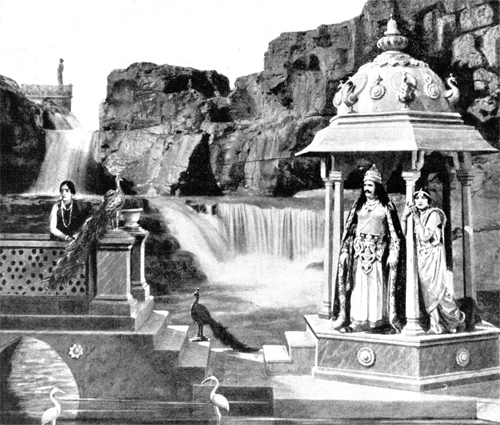
D.G. Phalke, Still from Bridging The Ocean / Setu Bandhan,
1932
The Secret History of Indian Cinema
This programme presents revelatory and rare films from two founding
periods of Indian cinema. D.G. Phalke’s fantastic films, like
those of George Méliès in France, are the foundations
of Indian cinema. Phalke, the “father of Indian cinema,”
gave magical movement to Indian mythology when he produced Raja
Harishchandra the first ever Indian film in 1913. Inventive and
playful, these films merge folk theatre with epic literature, myth
with modernity. Showing with these are films produced under the
government’s ‘Films Division’. Founded in 1948,
with the aim of documenting independent India, these works reflect
the processes of post-colonial nation building. Similar to the British
GPO Film Unit, filmmakers were given free reign in the 60s and 70s
to explore the possibilities of cinema from animation and impressionistic
documentary to subversive collages.
Cinema of Prayoga is a unique touring exhibition of artists' film
and video work from India; making available for the first time in
the UK this rich and unseen history.
Over the past three years no.w.here (London) has worked closely
with its partner organisation Filter (Mumbai) to establish the Experimenta
festival in Mumbai and Delhi, providing a platform for international
artists' film and video in India. During this period they have explored
a rich vein of visual-arts based work that despite the huge popularity
of Indian cinema remains relatively unknown. This project brings
a comprehensive selection of innovative work from outside of 'Bollywood'
film that India is traditionally known for. These works trace a
history of personal film and video free from the constraints of
the film industry and drawing on a broader array of the arts from
folk tales to poetry and music to dance, as well as myths and fantasy.
Cinema of Prayoga reflects the little known and diverse worlds of
historic and contemporary India.
Accompanying the Cinema of Prayoga programmes and national tour
will be a no.w.here publication:
"Cinema of Prayoga: Indian Experimental Film and Video 1913-2006"
Films
(all originate on film but will screen on Beta SP video)
Raja Harishchandra, D.G. Phalke, 1913, 20mins, silent,
b/w
Premiered on April 21, 1913, in Mumbai, Phalke’s first full
length feature stars a man named Salunke as the “Leading Lady“,
since women didn’t get to act in movies at the time. Only
one reel survives of the king who suffers to prove his commitment
to truth.
Lanka Aflame / Lanka Dahan, D.G. Phalke, 1917, 9mins, silent,
b/w
A mythological retelling of the familiar Ramayana story in which
Rama's wife Sita is abducted by Ravana, the demon king of Lanka,
and then rescued by Rama and his army of men, monkeys and bears.
The climax sees the brave monkey god Hanuman set the island of Lanka
afire with his burning tail.
The Birth Of Shri Krishna / Shri Krishna Janam, D.G. Phalke,
1918, 6mins, silent, b/w
This short has spectacular trick effects for the time. It depicts
an infant Krishna (played by Phalke’s daughter Mandakini),
rising out of the water balanced on the head of the demon snake
Kaliya, and also Krishna’s uncle Kamsa, dreaming that his
head, magically severed, rises and descends from his shoulders.
Bridging The Ocean / Setu Bandhan, D.G. Phalke, 1932, 9mins,
silent, b/w
Lord Rama and his army of apes and other creatures attempt to cross
the sea to reach Lanka - the domain of Ravana - to rescue the abducted
Sita. To do so a bridge of pebbles and stones is built by squirrels,
and Sita is rescued. Made at the end of the silent period this film
is a bridge between the silent and the talkie era.
And I Make Short Films, S.N.S Sastry, 1968, 16mins, sound,
b/w
An impressionistic and anarchic portrayal of a short filmmaker.
Dynamic editing mixes a range of footage from cartoons to documentaries,
and is accompanied by the bitter, humorous and satirical views of
the filmmaker.
Trip, Pramod Pati, 1970, 4mins, sound, b/w
A film on Bombay, using pixilation and an abstract soundtrack to
depict the evanescence of urban daily life. The quintessential Indian
experimental “city film.”
Child on a Chess Board, Vijay B Chandra, 1979, 8mins, sound,
b/w
This abstract narrative, dealing with the parallel themes of “Man
with all knowledge” and “Child the father of man”,
is a psycho-social exploration of nationhood, industrial progress
and scientific development, as seen through the eyes of a child.
Explorer, Pramod Pati, 1968, 8mins, sound, b/w
A psychedelic trip through ‘60’s youth culture in India.
An analysis of science, technology and modernity with abstract references
to symbols, faces and moods.
|
